

Gas Treating Catalysts Market Forecast 2026–2036: Market to Reach USD 7,678.3 Million by 2036 at 4.7% CAGR
Rising sulfur recovery standards, refinery modernization, and hydrogen infrastructure investments sustain long-term catalyst demand.
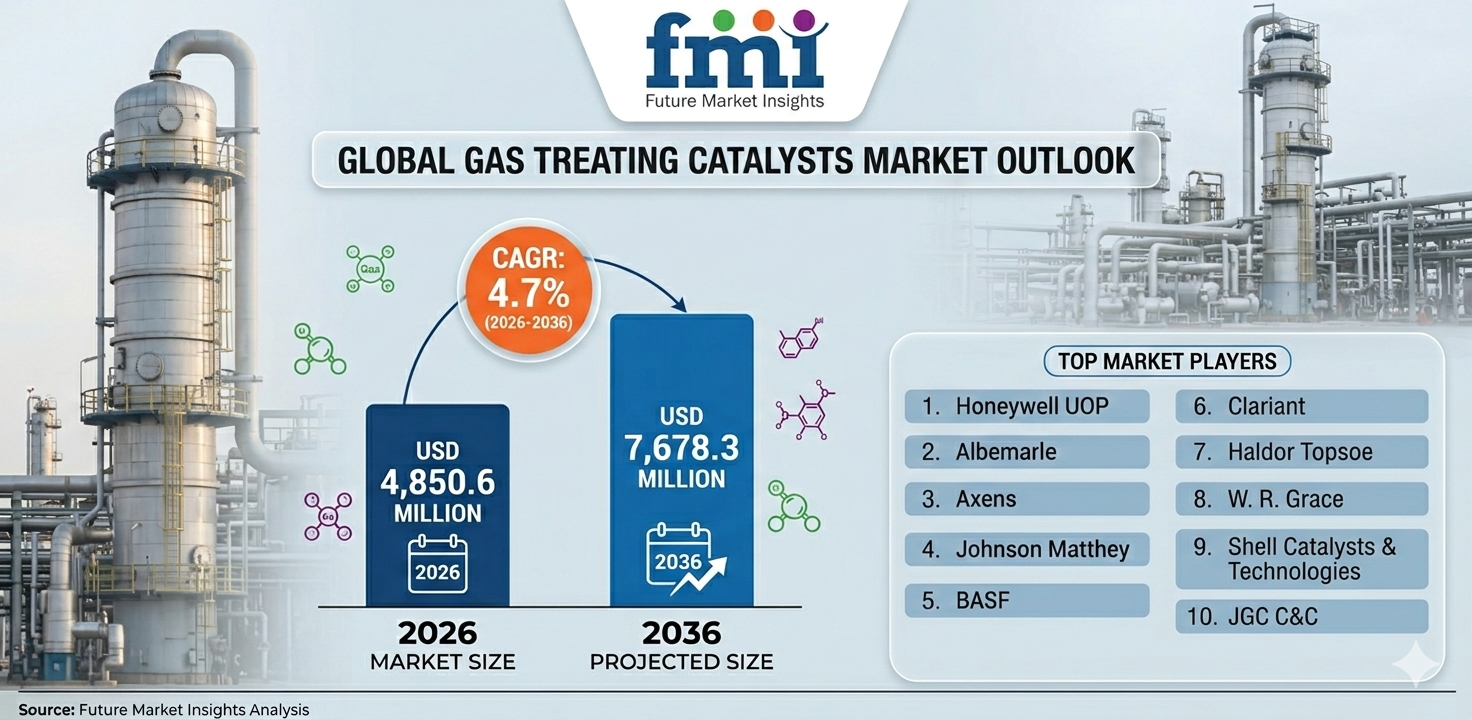
NEWARK, DE, UNITED STATES, February 27, 2026 /EINPresswire.com/ -- According to Future Market Insights, the global Gas Treating Catalysts Market is estimated to reach USD 4,627.5 million in 2025 and expand to USD 4,850.6 million in 2026. The market is projected to attain USD 7,678.3 million by 2036, reflecting a CAGR of 4.7% during 2026 to 2036. Growth is closely linked to tightening sulfur emission mandates, increased processing of heavier and sour feedstocks, and stronger focus on catalyst durability under fluctuating contaminant loads.
The market is expected to generate an absolute dollar opportunity of USD 2,827.7 million between 2026 and 2036, translating into a growth multiple of nearly 1.6 times over the forecast period. Expanding hydroprocessing severity, higher guard-bed utilization, and investment in sulfur recovery and tail gas treatment performance—where compliance is measured at the stack—continue to reinforce steady expansion.
Gas Treating Catalysts Market Snapshot (2026–2036)
• Market size in 2026: USD 4,850.6 million
• Market size in 2036: USD 7,678.3 million
• CAGR (2026–2036): ~4.7%
• Leading catalyst type: Hydrotreating (HDS/HDN) catalysts
• Dominant metal chemistry: CoMo-based catalysts
• Top end-use segment: Refineries
• Largest market: United States
• Key companies: Global catalyst manufacturers and process licensors
Market Momentum
The Gas Treating Catalysts Market enters 2026 supported by refinery upgrades targeting ultra-low sulfur fuel production and increasing sour crude processing. Between 2028 and 2032, hydrogen optimization strategies and sulfur recovery unit enhancements accelerate replacement cycles for hydrotreating and tail-gas catalysts.
By 2036, demand strengthens further as blue hydrogen, renewable fuel co-processing, and carbon capture integration require contaminant-tolerant catalyst systems capable of operating under high-pressure, multi-contaminant environments. Performance validation, regeneration economics, and predictable cycle lengths remain central to procurement decisions.
Request For Sample Report | Customize Report |purchase Full Report - https://www.futuremarketinsights.com/reports/sample/rep-gb-32110
Why the Market is Growing
The market is expanding as refiners and gas processors confront stricter environmental compliance requirements and increasingly complex feedstock compositions. Ultra-low sulfur fuel mandates continue to drive demand for advanced hydrodesulfurization (HDS) catalysts capable of maintaining hydrogenation efficiency while minimizing deactivation risks.
In parallel, expansion of blue hydrogen and syngas facilities is elevating demand for guard catalysts and hydrogenation systems resistant to poisoning from sulfur, nitrogen, mercury, and trace contaminants. As sour gas reservoirs and heavy crude processing intensify globally, catalyst durability and lifecycle optimization have become strategic priorities rather than routine maintenance considerations.
Digital reactor modeling, microreactor screening, and predictive catalyst health analytics are further redefining qualification timelines and enabling refiners to reduce unplanned shutdown risks.
Segment Spotlight
1. Catalyst Type: Hydrotreating (HDS/HDN) Catalysts Lead
Hydrotreating catalysts account for approximately 44% of total market share. Their dominance reflects continuous refinery throughput, strict sulfur reduction mandates, and frequent catalyst replacement cycles aligned with turnaround schedules. Advanced Co-Mo and Ni-Mo formulations support deeper sulfur removal under severe operating conditions.
2. Metal Chemistry: CoMo Segment Dominates
Cobalt-molybdenum (CoMo) catalysts represent nearly 37% of the market. Their strong sulfur removal efficiency, operational stability, and economic viability make them preferred choices in hydroprocessing units handling high-sulfur feedstocks.
3. End Use: Refineries Remain Core Consumers
Refineries hold around 52% share of overall demand. Continuous hydrogenation operations, large catalyst loading volumes, and stringent fuel specifications sustain steady replacement cycles and validation testing requirements.
Drivers, Opportunities, Trends, Challenges
Drivers:
• Tightening sulfur emission regulations
• Rising sour crude and acid gas processing
• Hydrogen economy expansion
Opportunities:
• Blue hydrogen and ammonia projects
• Renewable fuel co-processing
• Carbon capture integration
Trends:
• Performance-guaranteed catalyst contracts
• Digital monitoring and predictive analytics
• Regeneration and circular catalyst strategies
Challenges:
• Catalyst poisoning risks
• Hydrogen cost volatility
• Complex regeneration logistics
Country Growth Outlook (2026–2036)
The United States leads in market value, expanding at a CAGR of 4.2%, supported by advanced refining infrastructure and stringent ultra-low sulfur regulations. China grows at 5.8% CAGR due to refining capacity additions and coal-to-chemicals integration. India emerges as the fastest-growing major market at 6.6% CAGR, driven by refinery expansions and clean fuel mandates.
Saudi Arabia (4.9%) benefits from heavy-crude hydroprocessing investments, while Germany (3.6%) and Japan (3.1%) witness moderate growth driven by efficiency-focused catalyst optimization. South Korea records steady 4.0% CAGR growth supported by petrochemical-refinery integration.
Competitive Landscape
The market remains moderately consolidated, led by global catalyst manufacturers and licensors such as Honeywell UOP, Axens, Clariant, Johnson Matthey, BASF, and Haldor Topsoe.
Competition centers on catalyst activity retention, poisoning resistance, hydrogen efficiency, and lifecycle service capabilities. Suppliers increasingly bundle catalysts with proprietary process technologies, regeneration services, and digital performance monitoring to secure long-term refinery partnerships.
Recent consolidation activities, including acquisition-driven expansion of regeneration capabilities, highlight the growing importance of circular catalyst management and ex-situ activation services.
Frequently Asked Questions (FAQ)
What is the projected size of the Gas Treating Catalysts Market by 2036?
The market is expected to reach USD 7,678.3 million by 2036.
What is the expected growth rate from 2026 to 2036?
The market is projected to grow at a CAGR of approximately 4.7%.
What are gas treating catalysts used for?
They remove sulfur compounds, nitrogen species, carbon oxides, mercury, and other contaminants from industrial gas streams across refineries, natural gas processing, hydrogen production, and petrochemical facilities.
What factors are driving market expansion?
Stricter sulfur recovery standards, sour gas processing growth, refinery modernization, and hydrogen infrastructure expansion are key drivers supporting long-term demand.
Explore More Related Studies Published by FMI Research:
Metal Electrical Conduit Market https://www.futuremarketinsights.com/reports/metal-electrical-conduit-market
Solar PV Recycling Market https://www.futuremarketinsights.com/reports/solar-pv-recycling-market
Agriculture Solar Water Pumps Market https://www.futuremarketinsights.com/reports/agriculture-solar-water-pumps-market
About Future Market Insights (FMI)
Future Market Insights, Inc. (FMI) is an ESOMAR-certified, ISO 9001:2015 market research and consulting organization, trusted by Fortune 500 clients and global enterprises. With operations in the U.S., UK, India, and Dubai, FMI provides data-backed insights and strategic intelligence across 30+ industries and 1200 markets worldwide.
Why FMI: https://www.futuremarketinsights.com/why-fmi
Sudip Saha
Future Market Insights Inc.
+1 347-918-3531
rahul.singh@futuremarketinsights.com
Legal Disclaimer:
EIN Presswire provides this news content "as is" without warranty of any kind. We do not accept any responsibility or liability for the accuracy, content, images, videos, licenses, completeness, legality, or reliability of the information contained in this article. If you have any complaints or copyright issues related to this article, kindly contact the author above.
