

Feeling the heat unevenly: energy prices and household consumption
Prepared by Alina Bobasu and Michael Dobrew
The war in the Middle East has led to a sharp rise in real energy prices which is likely to weigh on euro area economic activity. This conflict has once again highlighted; the vulnerability of the euro area to energy price shocks. Brent crude oil prices increased markedly following the outbreak of the war in late February, reflecting disruptions to crude oil supplies through the Strait of Hormuz and a decline in oil production in the Middle East. Being a large net importer of energy, the euro area experiences such a shock as an effective transfer of real income to the rest of the world − an economic burden which is distributed unevenly across households.[1] This box examines the mechanisms behind the aggregate and distributional effects of energy price shocks on euro area household consumption, drawing on a quantitative heterogeneous agent New Keynesian model.
Rising energy price affect the terms of trade of energy-importing economies and erode purchasing power. In a large net energy-importing open economy such as the euro area, an energy price shock acts as a transfer of real income to the rest of the world, worsening the terms of trade and compressing real incomes.[2] As shown in Chart A, the sharp rise in real energy prices from their 2020 trough was accompanied by a marked deterioration in the terms of trade, reflecting the rising cost of imported energy commodities compared with domestically produced goods.[3] This deterioration weighed significantly on household real disposable income and, in turn, on private consumption.
Chart A
The real energy price index and terms of trade
(2015 = 100)

Sources: Eurostat, ECB and ECB calculations.
Notes: The “real energy price index” is the ratio of the energy component of the Harmonised Index of Consumer Prices (HICP) measure of inflation to the overall HICP index. The terms of trade are proxied by the ratio of the GDP deflator to the private consumption deflator. The latest observations are for the first quarter of 2026 for the terms of trade and the second quarter of 2026 for the real energy price index.
This adverse impact on the terms of trade and real incomes is felt very differently across households, as lower income households spend a larger share of their household budget on energy and have fewer resources to absorb such price shocks.[4] The lowest income quintile spends around 9% of its disposable income on energy, compared with an average of roughly 5.5% (Chart B, panel a). These households are also less able to absorb such price shocks since they dissave, with a median saving rate of around -5.8% of disposable income in the bottom income quintile. They therefore lack the necessary savings to smooth consumption and rely almost entirely on labour income, which thus exposes them to negative growth effects (Chart B, panel b).
Chart B
Energy spending and exposure of savings across households
a) Energy spending across household income quintiles
(as a percentage of disposable income)

b) Exposure of savings across household income quintiles
(as a percentage of disposable income)
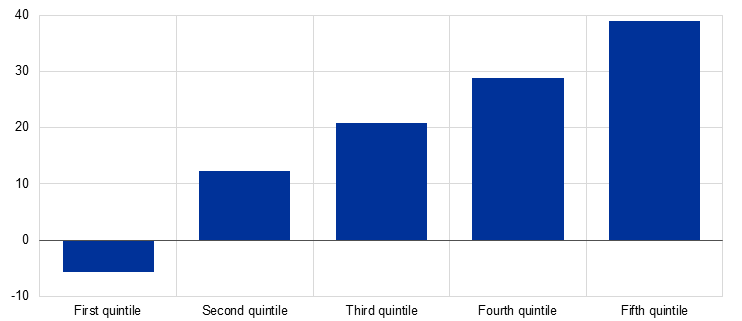
Sources: Eurostat, ECB and ECB calculations.
Notes: The chart is based on distributional statistics from the “Household budget survey” and the experimental statistics from the “Income, consumption, and wealth” datasets provided by Eurostat. The data refer to annual averages for 2020.
We use a quantitative heterogeneous agent New Keynesian model calibrated to the euro area to monitor how the exposure of household savings translates into a dynamic consumption response.[5] This model treats energy as both a consumption good and a production input, with all energy being imported, such that any price increase feeds directly into a loss of domestic purchasing power. Households differ in terms of their income and wealth, and therefore also in the share of their budgets allocated to energy, with lower income households spending more in relative terms than higher income households. The model is calibrated to match these features, as well as to the significant share of euro area households that have little or no savings. As a result, some households are liquidity constrained and hence unable to smooth consumption over time, leading to a higher marginal propensity to consume from their current labour income.[6] We calibrate an energy price shock to match the increase in the real energy price index in the second quarter of 2026 compared with the 2025 average of this price index. Our analysis assumes that real interest rates remain unchanged. We therefore focus on how the energy price shock transmits to consumption through labour income and relative price channels.
The energy price shock is unambiguously recessionary, dampening aggregate consumption primarily through losses in real disposable income. As most energy commodities in the euro area are imported, higher energy prices act as an income transfer to the rest of the world, which, in turn, needs to be distributed across domestic households and firms. Because energy and labour are complementary input factors in the production process, firms cannot easily substitute away from costlier energy and therefore scale back production as well as labour demand. This leads to lower real wages and lower employment levels, thus amplifying the initial income loss (Chart C). Around 80% of the decline in aggregate consumption reflects these indirect real income losses, with only 20% due to the direct loss in purchasing power resulting from higher energy prices. Importantly, the model abstracts from other confidence and uncertainty channels which can amplify or alter the transmission of the energy price shock, depending on the broader economic and geopolitical context.[7]
Chart C
Aggregate consumption response to higher energy prices
(percentage deviation from baseline)

Source: ECB staff calculations.
Notes: The chart shows the decomposition of the aggregate consumption response to a real energy price shock. This shock is calibrated to match the increase in the real energy price index in the second quarter of 2026 compared with the 2025 average of this price index. The “labour income effect” reflects changes in consumption stemming from changes in the path of real wages and employment. The “relative price effect” reflects changes in consumption stemming from a change in relative energy prices. For further details, see also Appendix B in Bobasu et al. (2025). The x-axis shows quarters after the initial shock.
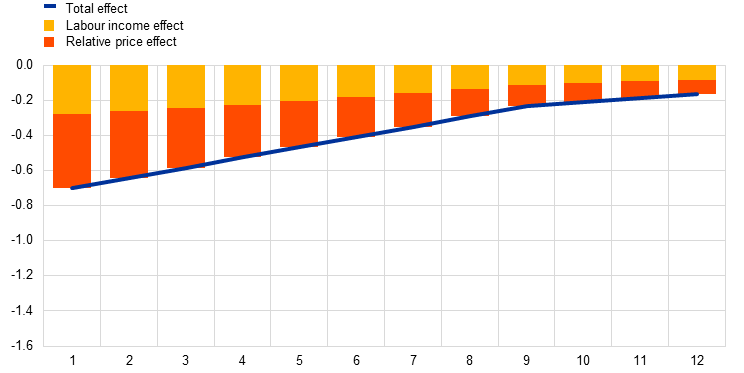
The decline in aggregate consumption masks substantial heterogeneities, with liquidity-constrained households bearing a disproportionately larger burden than others. Liquidity-constrained households are more severely affected by higher energy prices as a result of two mutually reinforcing channels.[8] First, for these households, energy constitutes a larger share of their spending and – often being close to subsistence level – they cannot easily substitute away from such purchases. Consequently, any rise in energy prices consumes a larger share of their disposable income compared with unconstrained households. Second, liquidity-constrained households rely more heavily on labour income and typically have fewer savings, leaving them with little capacity to smooth consumption over time as both employment and wages contract. Unconstrained households, by contrast, are able to draw on a wider range of income sources and typically have sufficient savings to cushion such a shock. As a result, consumption falls twice as much for liquidity-constrained households – roughly 1.4% as against 0.7% for unconstrained households upon initial shock – underlining the regressive impact of energy price shocks on private consumption (Chart D).[9]
Chart D
Consumption decomposition for liquidity-constrained and unconstrained households in response to higher energy prices
a) Liquidity-constrained households
(percentage deviation from steady state)

b) Unconstrained households
(percentage deviation from steady state)
Source: ECB staff calculations.
Notes: The chart shows the decomposition of the consumption response of liquidity-constrained and unconstrained households under a neutral monetary policy stance. Liquidity-constrained households are those in the lowest wealth quintile, whereas unconstrained households are those in the second highest wealth quintile. The energy price shock is calibrated to match the increase in the real energy price index in the second quarter of 2026 compared with the 2025 average of this price index. The “labour income effect” reflects changes in consumption stemming from changes in the path of real wages and employment. The “relative price effect” reflects changes in consumption stemming from a change in relative energy prices. The x-axis shows quarters after the initial shock.
Higher energy prices following the outbreak of the war in the Middle East have tended to have a regressive impact on household budgets, which, in turn, has affected the way the price shock has transmitted to aggregate consumption. As most energy commodities in the euro area are imported, higher energy prices act as an income transfer to the rest of the world, which affects households unevenly.[10] Should energy prices remain elevated, these distributional pressures are likely to play a role in the response of aggregate consumption. At the same time, other confidence and uncertainty channels seem to be important in the transmission of the latest energy price shock, as the war in the Middle East has led to a rise in geopolitical uncertainty.[11] Finally, while the US-Iran Memorandum of Understating initially improved the prospect of a lasting reversal of oil prices, thereby easing the loss of purchasing power and its impact on private consumption, the latest developments have clouded the outlook. As a result, elevated energy prices are likely to prove more persistent, prolonging the drag on household real incomes and consumer spending.
References
Andersson, M., Bobasu, A., Saiz, L. and Scrofani, S. (2026), “The cost of not knowing: how uncertainty weighs on the euro area economy”, Economic Bulletin, Issue 5, ECB.
Arce, Ó., Battistini, N., Bouabdallah, O., Lis, E. and Mohr, M. (2026), “A tale of two energy crises – initial conditions matter”, The ECB Blog, ECB, 3 June.
Bankowski, K., Bouabdallah, O., Checherita-Westphal, C., Freier, M., Jacquinot, P. and Muggenthaler, P. (2023), “Fiscal policy and high inflation”, Economic Bulletin, Issue 2, ECB.
Battistini, N., Di Nino, V., Dossche, M. and Kolndrekaj, A. (2022), “Energy prices and private consumption: what are the channels?”, Economic Bulletin, Issue 3, ECB.
Battistini, N., Bobasu, A. and Gareis, J. (2023), “Who foots the bill? The uneven impact of the recent energy price shock”, Economic Bulletin, Issue 2, ECB.
Battistini, N., Bobasu, A., Dinis Rigato, R. and Kase, H. (2026), “Save your energy: how the war in the Middle East could affect household savings and the economy”, Economic Bulletin, Issue 3, ECB.
Bobasu, A., Charalampakis, E. and Kouvavas, O. (2024), “How have households adjusted their spending and saving behaviour to cope with high inflation?”, Economic Bulletin, Issue 2, ECB.
Bobasu, A., Dobrew, M. and Repele, A. (2025), “Energy price shocks, monetary policy and inequality”, European Economic Review, Vol. 175, Article 104986.
Bokan, N., Dossche, M. and Rossi, L. (2018), “Oil prices, the terms of trade and private consumption”, Economic Bulletin, Issue 6, ECB.
Dausà i Noguera, N., Dimou, M. and Kouvavas, O. (2026), “Tracing the ripple effects of the Middle East war on euro area consumption”, Economic Bulletin, Issue 5, ECB.
Gareis, J. (2026), “Higher oil prices from the war in the Middle East: assessing the headwinds for euro area growth”, Economic Bulletin, Issue 4, ECB.
Legal Disclaimer:
EIN Presswire provides this news content "as is" without warranty of any kind. We do not accept any responsibility or liability for the accuracy, content, images, videos, licenses, completeness, legality, or reliability of the information contained in this article. If you have any complaints or copyright issues related to this article, kindly contact the author above.
